
March 30, 2026
"Self-Determination Is The Pathway to Liberation"
Alternative Mental Health Crisis Response in the United States
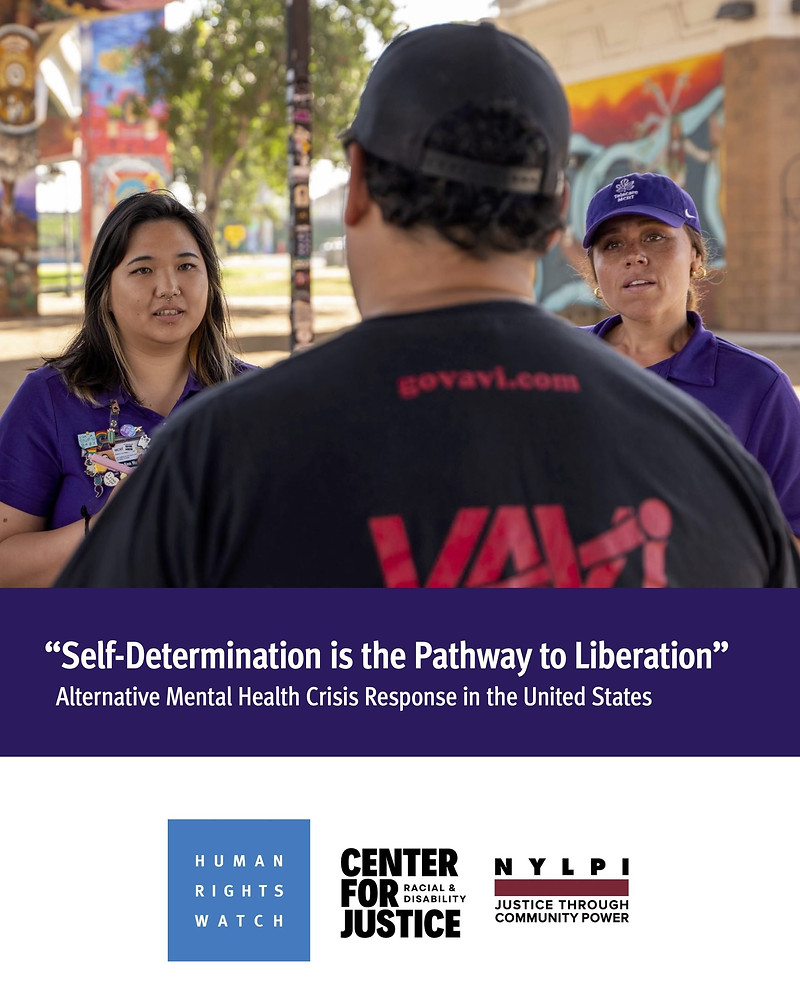
The Center for Racial and Disability Justice co-authored this report with Human Rights Watch and New York Lawyers for the Public Interest. Olivia Ensign (formerly HRW), Jordyn Jensen (CRDJ), and William Juhn (NYLPI) researched and wrote the report, which examines non-police, rights-based alternatives to mental health crisis response across the United States. Download the full report and read the press release below.
Press Release
US: Rights-Respecting Approaches to Mental Health Crisis
Survey of Programs Centered on Non-Police Response, Consent, Peer Involvement
-
Communities throughout the country are developing alternative models of mental health crisis response.
-
These approaches are desperately needed as US police kill hundreds of people each year, many of them people with documented mental health conditions, and as federal, state, and local jurisdictions seek to implement increasingly coercive approaches to mental health crisis response and treatment.
-
The report is designed to serve as a guidepost for programs across the country that seek to uphold human rights while effectively supporting the people they serve.
(New York, March 30, 2026) – Communities throughout the country are developing alternative models of mental health crisis response Human Rights Watch, New York Lawyers for the Public Interest, and the Center for Racial and Disability Justice at UCLA School of Law said in a report released today. These approaches are desperately needed as US police kill hundreds of people each year, many of whom had documented mental health conditions, and as federal, state, and local jurisdictions seek to implement increasingly coercive approaches to mental health crisis response and treatment.
The 66-page report, “‘Self-Determination is the Pathway to Liberation’: Alternative Mental Health Crisis Response in the United States,” identifies key elements of rights-respecting responses to mental health crises and explores how alternative mental health crisis response programs have carried out these approaches in practice. Many of these models share core elements, including promoting individual autonomy, providing voluntary support rather than mandating compliance, and avoiding unnecessary law enforcement involvement.
“Having police as the primary or default responders to people experiencing mental health crises is ineffective and sometimes lethal, given their orientation toward force and compliance,” said Tanya Greene, US program director at Human Rights Watch. “Fortunately, there are alternate approaches that emphasize personal autonomy and consent to treatment.”
Researchers studied over 150 crisis response programs from across the United States and feature eight that have committed to implement key aspects of supportive, rights-based mental health crisis response without police as primary or default responders. The researchers interviewed program administrators and, where possible, community members and advocates for unaffiliated perspectives on the programs. Researchers used international human rights law and standards as a tool for identifying key elements of rights-respecting programs.
In many cases, police presence escalates mental health crises and results in coercion and violence. People with mental health conditions are particularly at risk to police violence and are much more likely to be killed during police encounters than people without a disability. This risk is especially true for Black people and other people of color with mental health conditions. Police often tend to approach people in crisis with commands and calls for compliance in situations when a more nuanced and supportive interaction that peers—those with lived mental health experience—and mental health workers can provide is needed.
The eight programs featured in the report are based in communities around the United States. Some are connected to local government, while others operate independently. Their response teams differ in composition, though most include peers, social workers, emergency medical technicians or paramedics, and crisis intervention specialists. They typically respond on-site to the person experiencing a crisis, and provide a variety of services, including assessments, de-escalation, safety planning, crisis counseling, education, transportation, referrals to community resources, and follow-ups.
The programs were developed with the recognition that police-centered mental health crisis responses have often led to violence and harm to the person in need of support. Black people and other people of color have been especially exposed to that violence and harm, due in part to existing structural racism in policing, mental health care, and more generally throughout society.
Programs that emphasize non-coercive models and non-police responses seek to avoid that violence and provide more effective support for people experiencing crises by mobilizing and training peers and other professionals, steeped in the culture and communities they serve.
The metrics by which the programs were evaluated include eliminating police as primary or default responders, avoiding involuntary treatment, implementing a consent-centered approach to treatment, promoting participation of peers, providing trauma-informed and culturally responsive training, and maintaining a deep connection to the communities they serve. Researchers evaluated the programs’ commitment to providing accessible services, response times comparable with other emergency services, follow-up care, and minimization of power imbalances between service providers and those they support.
“These programs serve as examples for how we can truly serve individuals and communities to make their own decisions through support and care,” said William Juhn, senior staff attorney of the Disability Justice Program at New York Lawyers for the Public Interest.
While no one program purports to embrace or implement all these rights-respecting criteria, each program is oriented around at least some of them. Researchers did not evaluate outcomes and did not endorse any program’s particular model or approach to crisis response.
“As federal, state, and local governments move toward more coercive approaches to mental health crisis response, like involuntary commitments, hospitalizations, and forced medication, it is important to understand that programs honoring human rights do exist,” said Jordyn Jensen, community engagement and communications manager at the Center for Racial and Disability Justice.